


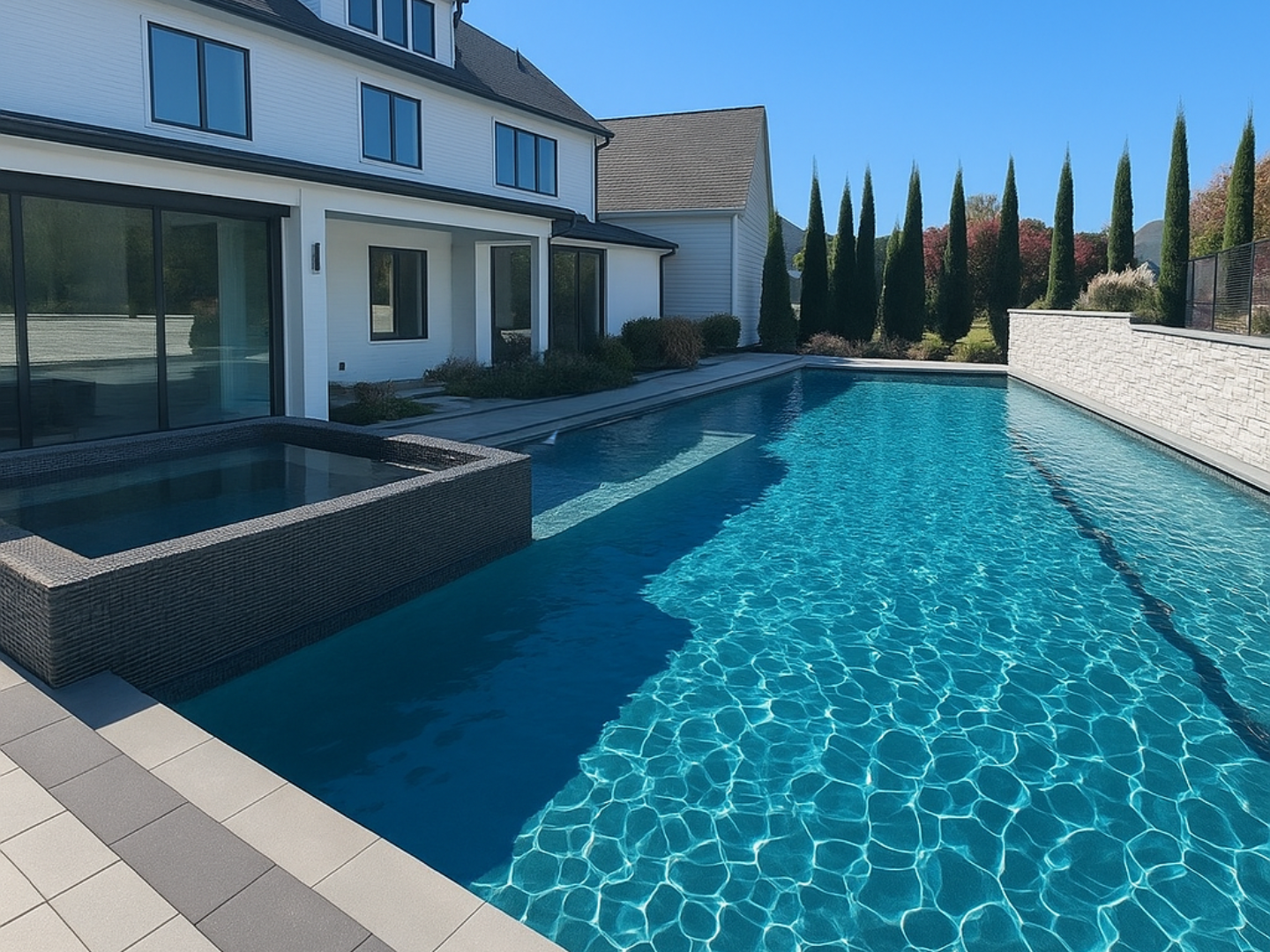
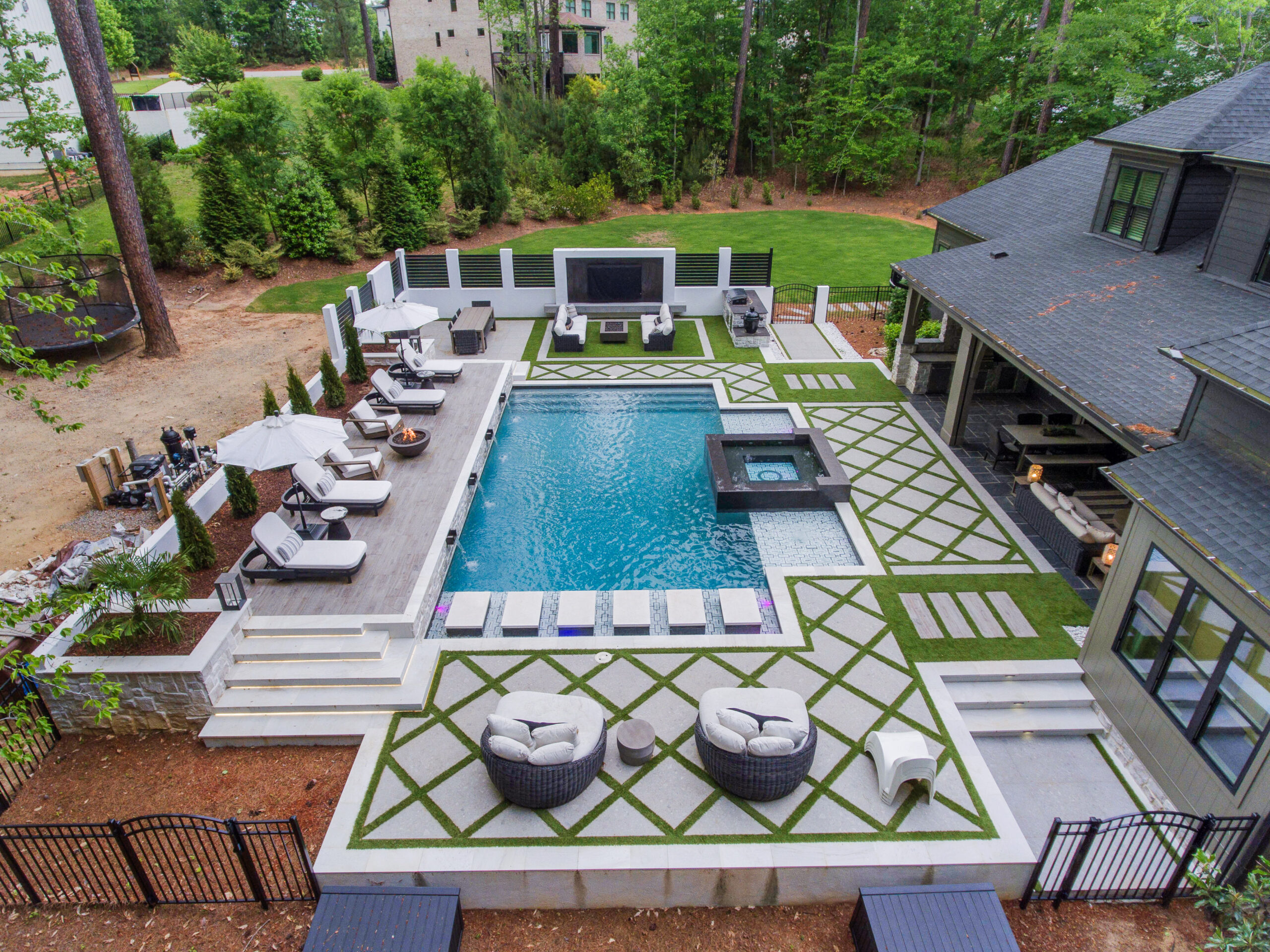
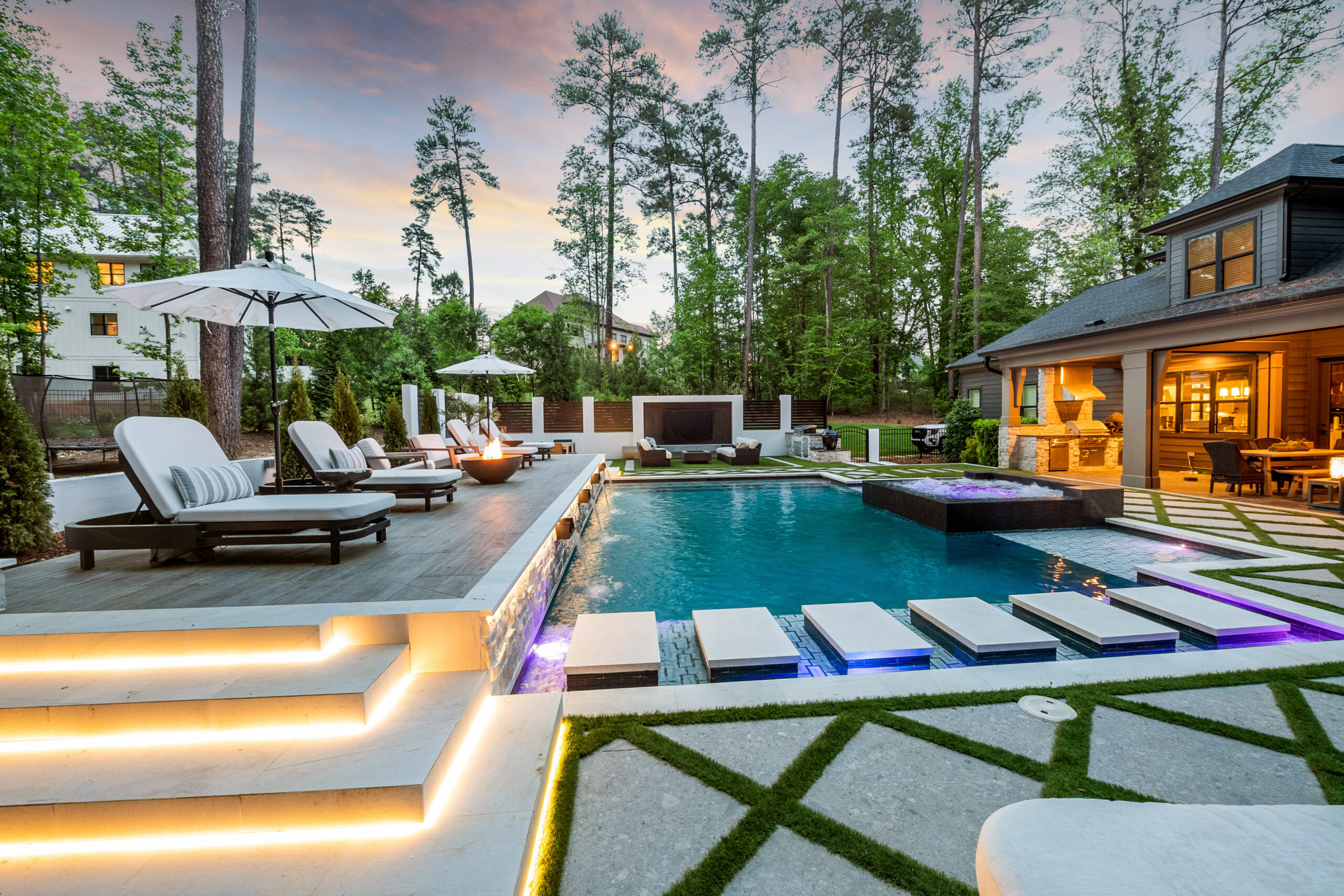
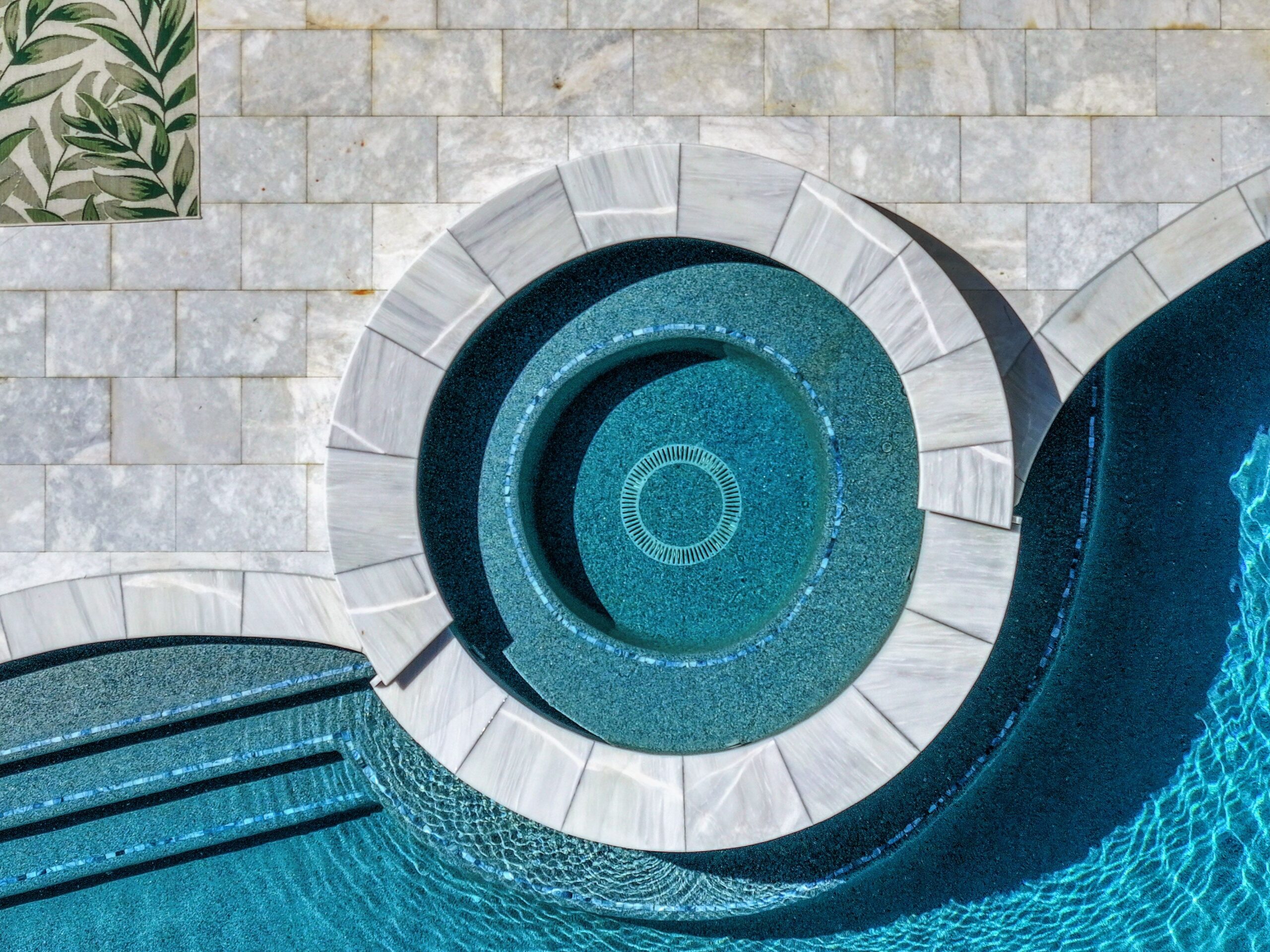
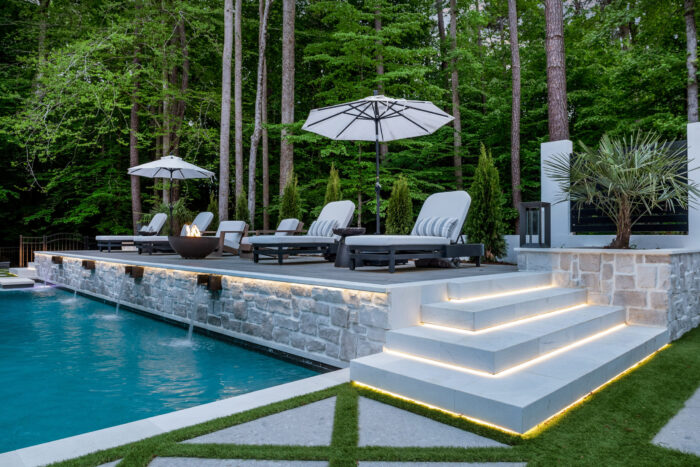
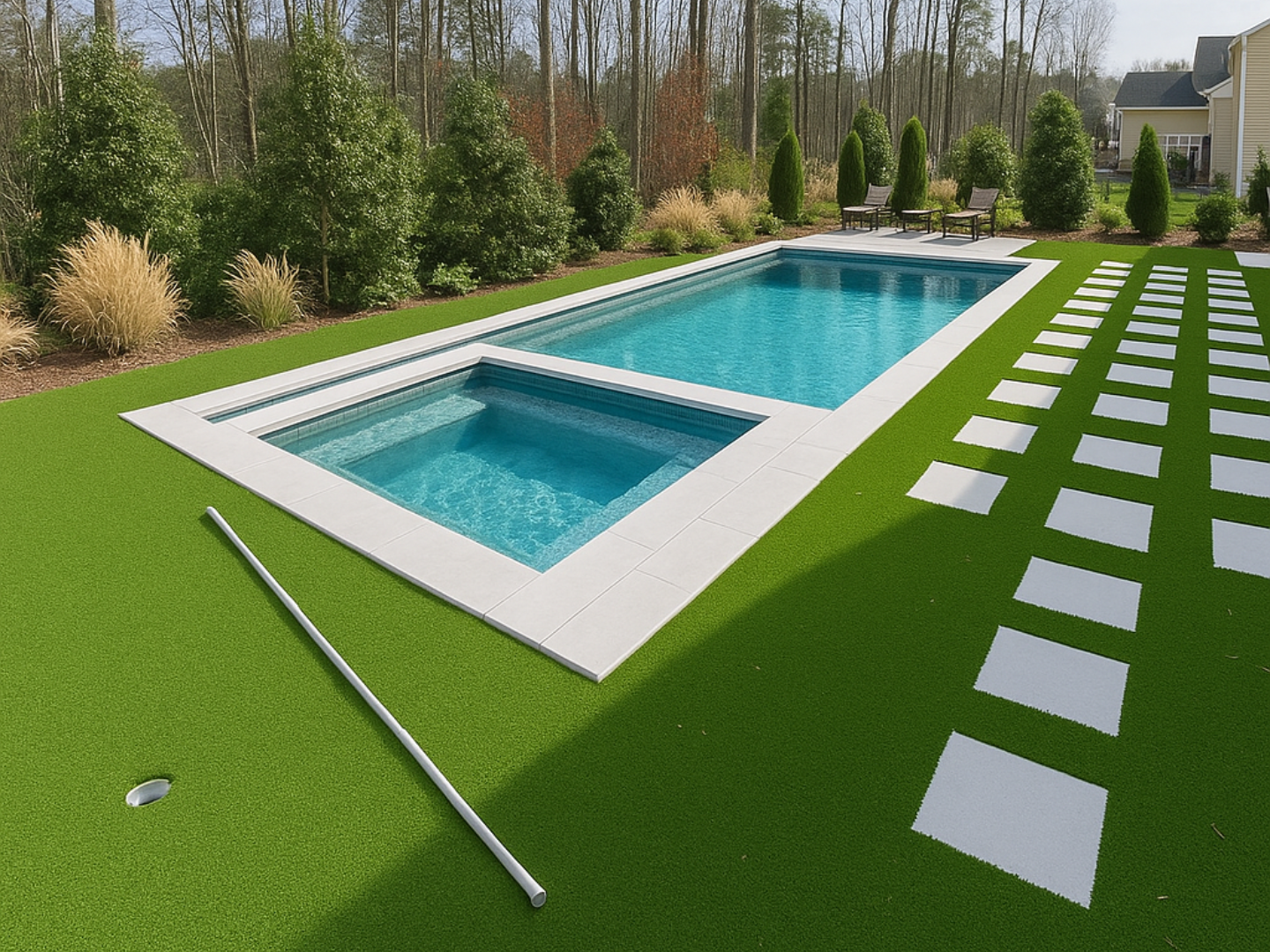
The deck surrounding your pool is the most-used surface in your outdoor environment. Every barefoot step from the house to the water crosses it. Every lounge chair sits on it. Every dinner guest sees it from across the yard. Choosing the best pool deck material is one of the most consequential design decisions in any custom backyard project.
It is not simply an aesthetic decision, though aesthetics matter enormously. It is a decision about how your deck will perform in 95-degree July heat, how it will feel underfoot when wet, how it will age next to the brick or transitional siding of your home, and how it will hold up over a decade of freeze-thaw cycles, humidity, and UV exposure in the Triangle.
This post compares travertine, porcelain pavers, and natural stone: the three materials most commonly specified for luxury pool decks across Cary, Durham, and Chapel Hill. Each has a distinct character. Each fits differently against the architectural styles most common in the Triangle’s premium neighborhoods. For homeowners who are planning a full backyard environment, material selection fits into a broader layout and design-build conversation, which we cover in our guide to pool and outdoor kitchen design for Triangle homes.

What Makes a Pool Deck Material High-Performing
Before comparing specific materials, it helps to understand what the job actually requires. A pool deck material needs to meet four performance criteria that are specific to the pool environment.
First, it needs to stay cool enough to walk on barefoot in summer. Darker materials and dense surfaces absorb heat. In a North Carolina July, a surface that gets too hot to touch is not a luxury deck; it is a barrier to using your pool.
Second, it needs to resist slip when wet. Texture, porosity, and finish treatment all affect slip resistance. Pool decks are wet almost every time they are in active use.
Third, it needs to hold its appearance across years of UV exposure, humidity, and seasonal temperature swings. Materials that look stunning at installation and dull or stain within three years are a poor long-term investment.
Fourth, it needs to complement the architecture of your home. The most beautiful stone in the world looks wrong if it fights the color palette or style of the house behind it. Material selection and home exterior are a conversation, not two independent choices.
Travertine Pool Decks: Natural Performance and Resort Character
Travertine is among the most naturally suited materials for pool decks. Formed from mineral springs, travertine has a natural micro-porosity that keeps its surface temperature significantly cooler than most alternatives, even in direct afternoon sun. For Triangle homeowners who prioritize barefoot comfort on hot days, a travertine pool deck in Cary or Durham performs better than almost any other surface available at a comparable price point.
Its warm, organic tones, spanning cream, walnut, gold, and ivory, read beautifully against the traditional brick colonials and craftsman-style homes that dominate the Triangle’s premium neighborhoods. Travertine is a natural material with variation in each piece, which means no two travertine pool decks look identical. That variation is part of its appeal.
The tradeoffs to understand: travertine is a softer stone than porcelain or granite, which means it can scratch or chip under heavy impact. Its porous surface requires sealing to resist pool chemicals and staining, and resealing every few years thereafter. Filled travertine, where the natural voids are grouted, is the standard pool deck specification. For homes in the Triangle with traditional or transitional exteriors, a travertine pool deck delivers a timeless, resort-caliber aesthetic with a performance profile that holds up well in the NC climate.

Porcelain Paver Pool Decks: Engineered Performance, Modern Character
Porcelain pavers are an engineered material, and their engineering solves several problems that natural stone cannot. They are dense and non-porous, which means zero water absorption, near-zero maintenance, and no sealing required. They are fade-resistant and chemically inert, meaning pool water and cleaning agents do not affect their surface over time. And they are available in formats that convincingly replicate the look of wood, slate, marble, and limestone at a fraction of the maintenance cost.
For contemporary and modern homes, large-format porcelain pool decks in a dark concrete gray or a matte sand tone are increasingly the specification of choice in Durham and Chapel Hill’s newer neighborhoods. Porcelain extends the architectural language of a clean-lined home outward into the landscape.
The performance consideration for porcelain is surface temperature. Dense porcelain absorbs heat more than travertine, particularly in darker colorways. Choosing a lighter tone and a finish with some texture addresses both concerns. Slip-resistant porcelain in a tumbled or brushed finish performs comparably to travertine for wet-surface traction.
Porcelain pavers are also extremely consistent piece to piece. Where travertine has natural variation, porcelain is uniform. For homeowners who want a precise, controlled aesthetic, that consistency is an asset. For homeowners who want a material that feels organic and alive, it is a limitation worth knowing about before committing.
Natural Stone Pool Decks: Character, Longevity, and Contextual Fit
Natural stone is a broad category. For pool decks in the Triangle specifically, the materials most commonly specified are bluestone, limestone, and granite. The Natural Stone Institute provides guidance on selecting and specifying natural stone for high-moisture exterior environments, including pool decks where chemical exposure and seasonal movement are ongoing concerns.
Bluestone is a dense, cool-toned quartzite that reads as sophisticated and architectural. It performs well in the NC climate, does not fade significantly, and pairs naturally with the darker brick and stone exteriors common in Chapel Hill’s older neighborhoods. Bluestone has a naturally textured cleft surface that makes it among the most slip-resistant natural stone options available.
Limestone is warmer and softer than bluestone. It stays cooler underfoot but requires more careful sealing and maintenance in a high-moisture pool environment. When properly sealed, limestone delivers a Mediterranean or Old World character that suits traditional homes exceptionally well.
Granite is the hardest and most durable natural stone option, resistant to scratch, stain, and fade. Specified in a thermal or flamed finish, it manages both slip resistance and heat retention effectively. For homeowners who want a natural material with maximum longevity and minimal maintenance, granite is worth a serious conversation with your designer.

Matching Deck Material to Your Home’s Exterior
The Triangle’s premium residential market includes three dominant exterior typologies: traditional brick (colonial, craftsman, Georgian influences), transitional (brick-and-stucco or brick-and-fiber-cement combinations), and modern (clean-lined, low-sloped roofs, large-format windows).
Travertine is the strongest performer against traditional brick exteriors. Its warm, natural tones pull the earth palette from brick and extend it into the landscape. Against transitional or modern homes, travertine can read slightly soft; porcelain in a limestone or concrete look is often a stronger match.
Porcelain in gray or concrete tones is the natural choice for modern homes. For transitional homes, it works equally well, particularly when paired with metal coping or a simple pool edge detail. Natural stone is the most contextually specific choice. Bluestone, for example, fits some Triangle homes beautifully and feels slightly out of register in others. Working with a designer who can evaluate your specific home and lot is the most reliable path to a material selection that feels intentional rather than arbitrary.
The Decision That Lasts as Long as the Pool
The best pool deck material for your home is the one that performs well in your specific climate exposure, holds its appearance across the lifetime of the pool, and extends the architectural character of your house into the backyard environment. None of the three materials covered here is universally right or wrong. Each is right in a specific context.
A natural stone pool deck in Chapel Hill NC, a porcelain paver deck on a modern Durham NC build, or a travertine surround for a traditional Cary NC home: the material that works is always the one chosen in relationship to the whole. That is a conversation that begins with your home and your vision.
Get material guidance from our designers at Jim Hinson Pools. We work through travertine, porcelain, and natural stone options in the context of your home’s exterior and your full backyard vision, so the material choice is never made in isolation.