


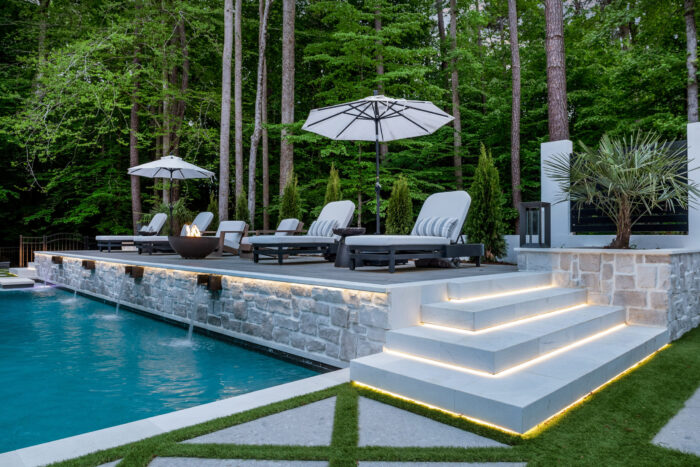
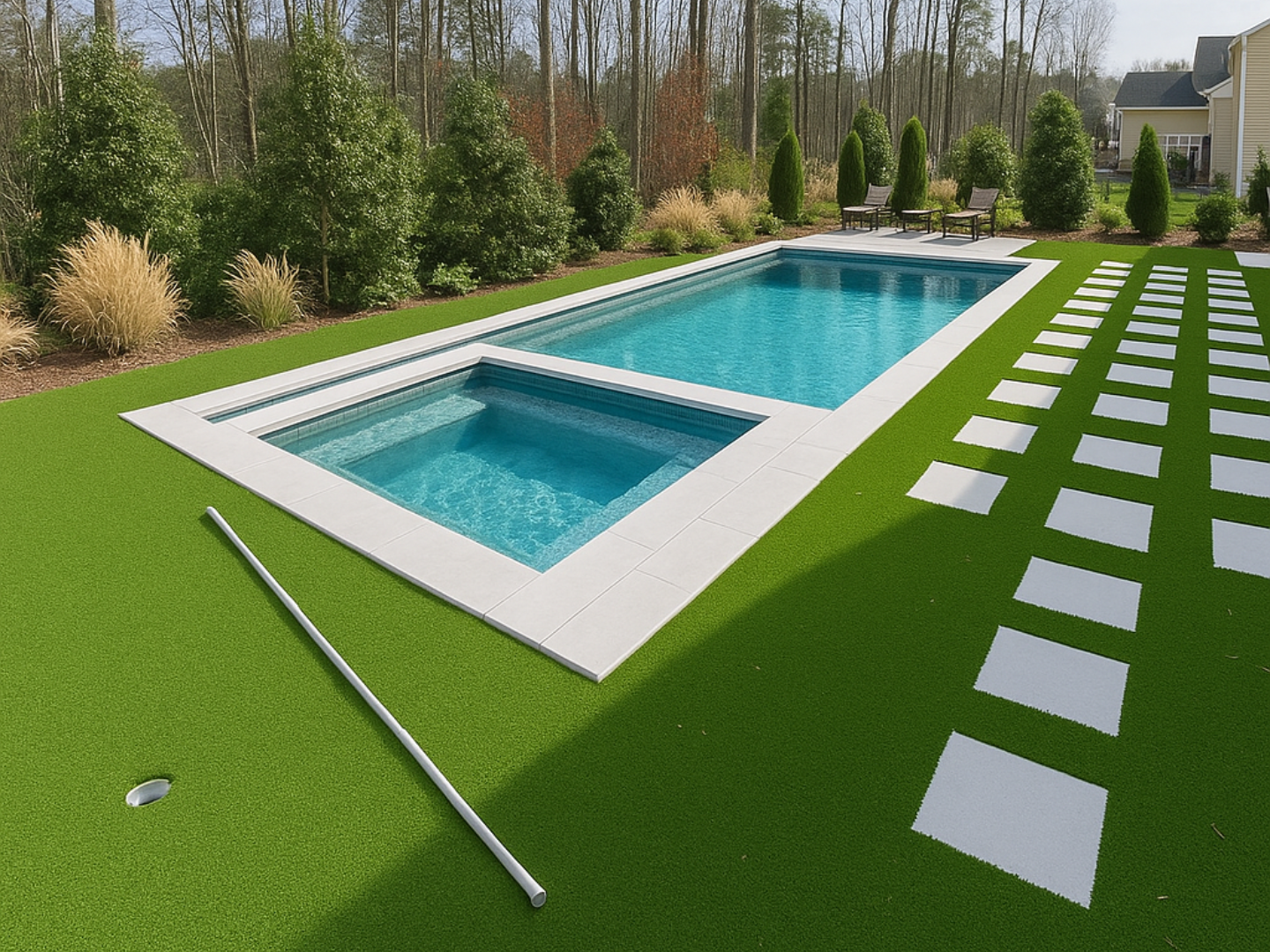
When most homeowners imagine their finished backyard, they see two things clearly: a pool and an outdoor kitchen. What they often do not picture clearly is the space between them, or how one connects to the other, or where guests naturally move when dinner is done and the evening is warm. That in-between space is where great pool and outdoor kitchen design actually happens.
This is not two separate decisions made at separate times. It is a single spatial problem, and the homeowners who solve it well get a backyard that feels designed. The ones who treat it as two independent projects often end up with a beautiful pool and a beautiful kitchen that never quite connect.
For homeowners across Cary, Durham, and Chapel Hill, the Triangle’s mix of lot sizes, setback requirements, and home architectural styles creates both opportunity and constraint. Understanding how to work within that context, from sun orientation to utility routing to material selection, is the difference between an outdoor space you tolerate and one you return to every evening.

Why Layout Comes Before Everything Else
Before materials are selected, before a single cabinet is specified, and before you commit to a pool shape, the layout question needs to be answered. Layout determines whether your backyard functions as an integrated environment or as a collection of disconnected features. It determines whether the kitchen is shaded when you need it to be, whether the pool is visible from the cooking area, and whether you have room to do both without cramping either.
This is why design-build coordination matters from the very first conversation. At Jim Hinson Pools, we begin with the full backyard environment in mind, not just the water feature. The pool, the kitchen, the decking, and the surrounding landscape are planned together so every element serves the whole.
Wet Zone and Dry Zone: The First Design Decision
Every backyard with a pool and an outdoor kitchen has two functional zones: wet and dry. The wet zone is the pool and its immediate surroundings, where swimmers enter and exit, where towels get dropped, and where water gets tracked. The dry zone is the kitchen, dining area, and conversation spaces.
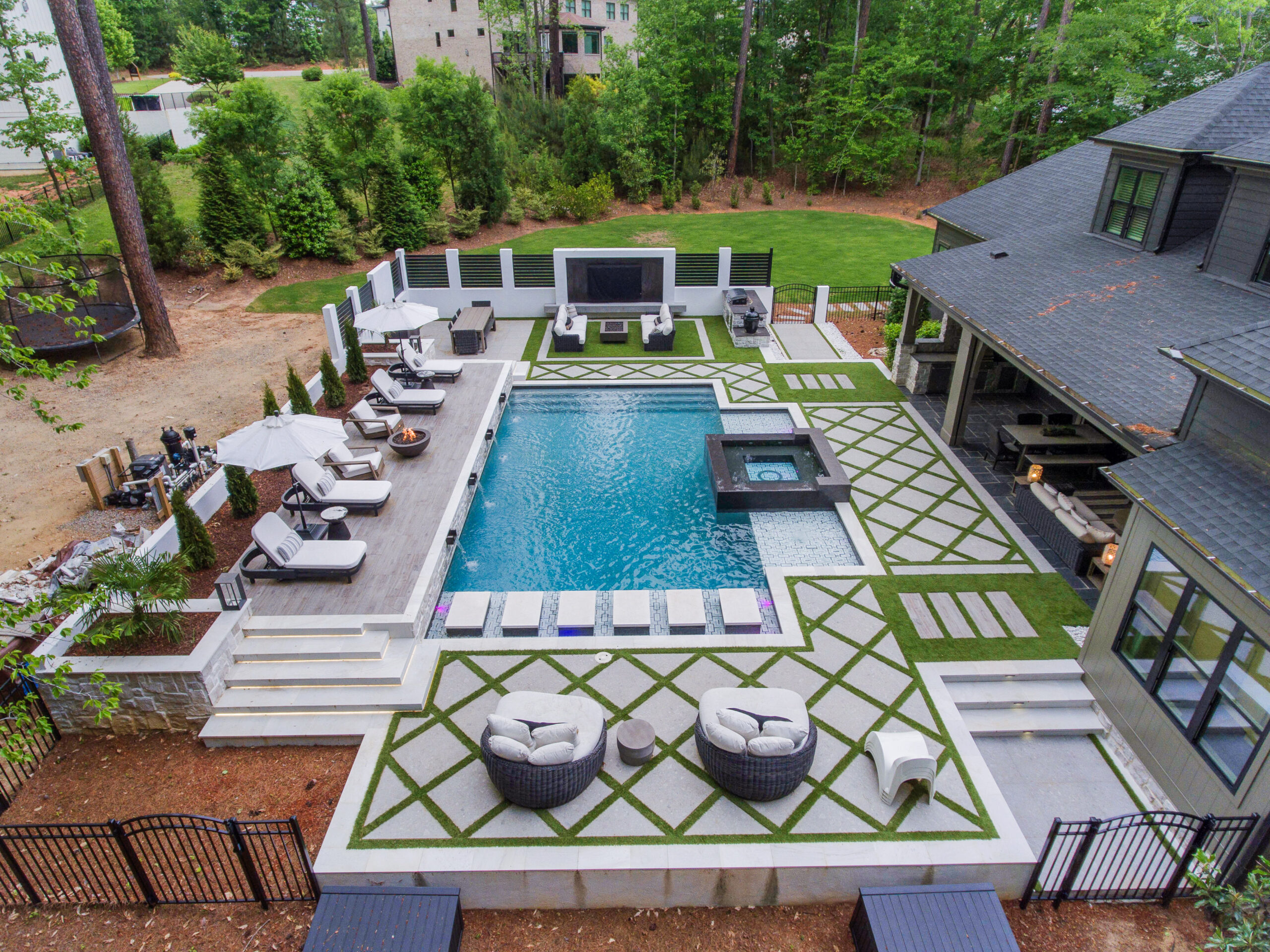
The principle is straightforward: these zones should be adjacent but distinct. You want clear physical and visual connection between cooking and swimming, so the cook is not isolated from the party. But you do not want wet feet tracking through the kitchen or guests cutting through the dining area every time they jump in the pool. A well-planned transition, whether a change in paving material, a step, or a low planting border, handles this naturally.
In Triangle homes with covered porches or existing screened-in spaces, the dry zone often anchors to that existing structure. In homes without covered outdoor space, a pergola or shade structure over the kitchen becomes part of the design problem from the start.
Sightlines: Designing for Connection
One of the most overlooked aspects of outdoor kitchen and pool layout is sightlines. The person cooking should be able to see the pool. This is not just practical (parents watching children), it is social. Guests congregate near the action, and if the cook cannot see or be seen from the water, the kitchen becomes a service station instead of a gathering point.
A simple way to test your sightlines before you build is to stand at the proposed cooking position and walk the arc of where guests will be. If you lose visual contact with the pool from more than a few steps away, the layout needs to shift.
The best layouts position the kitchen perpendicular to or at a slight angle from the pool edge, rather than directly facing it. This creates a natural conversation triangle between the cook, the water, and the seating area, and makes the whole backyard feel intentionally composed.
Sun Orientation and Shade Planning
Sun orientation matters differently for pools and kitchens. Pools benefit from sun exposure throughout the day; a north-facing pool is harder to heat and less pleasant to use in shoulder seasons. Kitchens are the opposite. Cooking at a west-facing grill in a North Carolina afternoon means cooking in direct sun at 4 PM, which is exactly when most dinners start.
For outdoor living in Chapel Hill, Durham, and Cary, a south-facing pool with a kitchen positioned on the east or north side of the yard gives the most usable outdoor environment across the full year. This is not always possible given lot constraints, but it is worth orienting your layout around whenever the site allows.
Shade structures, whether pergolas, sail shades, or articulating screens, can compensate for an unfavorable orientation. But they add cost and complexity. Getting the orientation right at the layout phase is always less expensive than engineering shade after the fact.

Utilities: The Hidden Layer of Outdoor Kitchen Design
Outdoor kitchens require gas, electrical, and water connections. Pools require water, electrical, and in some cases gas for heating. Both connect to systems inside or under your home. The Pool & Hot Tub Alliance recommends engaging a design-build partner early in the planning process specifically to coordinate these utility systems before any ground is broken, because conflicts discovered during excavation are far more expensive to resolve than conflicts caught on paper.
Locating the outdoor kitchen close to the house reduces utility run distance, but if the house sits to the north and the best kitchen orientation is to the south, that tradeoff has to be made consciously. A design-build partner who handles both pool and kitchen coordinates this as a single utility plan, not as two separate contractors working around each other.
This coordination is one of the clearest practical advantages of engaging a single firm for the full backyard environment. When pool plumbing, kitchen utilities, and electrical for lighting and audio are planned by one team, conflicts are resolved at the design stage, not in the field during an active build.
Material Continuity Across the Full Backyard
Material selection for pool decks and outdoor kitchen surrounds is covered in depth in our post on the best pool deck materials for Cary, Durham, and Chapel Hill, including how travertine, porcelain pavers, and natural stone each perform in the Triangle’s climate. At the layout planning stage, the question to answer is more fundamental: will the materials across your pool deck, kitchen surround, pathways, and house exterior feel like one cohesive environment, or like three different projects?
The homes in the Triangle’s premium neighborhoods range from traditional brick colonials to modern transitional builds to craftsman-influenced construction. Each home exterior has a natural material palette, and the outdoor environment should extend that palette outward, not fight it.
Material continuity is one of the clearest visual indicators of a designed backyard versus an assembled one. Homeowners who plan this at the layout stage, in coordination with their pool and kitchen designer, have dramatically better outcomes than those who make material selections in isolation.
Why Design-Build Coordination Is the Foundation
The single most common frustration homeowners share after a pool or outdoor kitchen build is that something was not coordinated. The kitchen went in, and then the pool contractor had to work around it. The deck material was selected before the pool shape was finalized. The outdoor lighting was specified without knowing where the kitchen circuit would land.
Design-build coordination is not a premium upgrade. It is the baseline condition for getting a backyard that works as a whole. At Jim Hinson Pools, our process begins with the full environment, including pool layout, outdoor kitchen placement, sun orientation, material continuity, and utility routing, as a single integrated plan. That coordination shows in the finished product, even when the work behind it is invisible.

The Backyard You Keep Coming Back To
Great outdoor environments are not complicated. They are coherent. A pool and outdoor kitchen that flow naturally from one another, that sit correctly in the sun, that connect to your home’s architecture, and that were built by a team who planned them together: that is the backyard you use every single night the weather allows.
The Triangle’s most beautiful outdoor living spaces did not happen because the homeowners made good individual choices. They happened because every choice was made in relationship to every other. That is what a design-build process delivers, and it starts with the very first conversation.
Frequently Asked Questions
What is the ideal distance between a pool and an outdoor kitchen?
There is no universal number, but most well-functioning layouts place the kitchen 15 to 25 feet from the pool edge. Close enough for clear sightlines and easy movement, far enough to create a natural separation between wet and dry zones.
Do I need permits for an outdoor kitchen in Cary, Durham, or Chapel Hill?
Yes. Outdoor kitchens with gas, electrical, and plumbing connections require permits in all three municipalities. Your design-build partner should coordinate permit applications as part of the project scope from the beginning.
Can I add an outdoor kitchen to an existing pool?
Yes, though retrofitting utilities around an existing pool adds some complexity and may constrain layout options. A site visit is the starting point for understanding what is possible and what coordination the project will require.
How long does a combined pool and outdoor kitchen project take?
From initial design through completion, most full backyard environments take 12 to 18 months, depending on permit timelines, material lead times, and project complexity. Starting the design conversation now is the most reliable way to be swimming by the summer you want.
Request a full-backyard design consult with Jim Hinson Pools to start mapping out an outdoor environment designed around your home, your lot, and the way your family lives.