


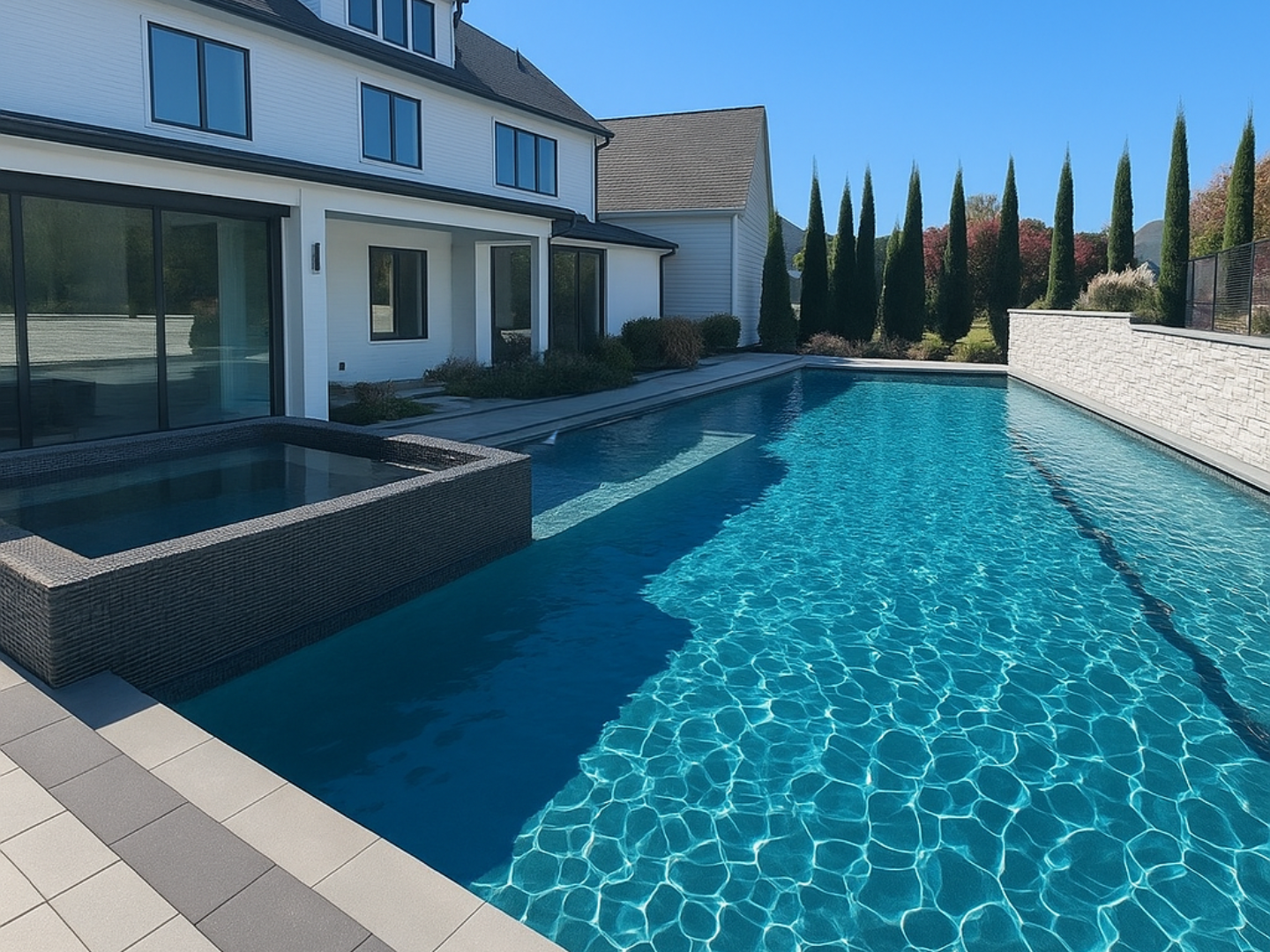
The first thing many homeowners say when they have a sloped backyard and a pool in mind is: I do not think we can do that here. It is an understandable reaction. A significant slope does add complexity to any construction project, but in nearly every case, it does not rule one out.
Building a pool for sloped yards requires a different kind of planning than building on flat ground. The excavation is more involved. The drainage needs more engineering. The structural elements, retaining walls, raised pool walls, and transitions between levels, become part of the design rather than an afterthought. And when those elements are handled well, the result is often more architecturally interesting than anything a flat lot could produce.
For homeowners across Cary, Durham, and Chapel Hill considering a pool on a challenging lot, this guide covers what is structurally possible, how the major engineering elements work, and how to think about the design decisions that turn a complex site into a standout outcome. If you are also thinking through the full backyard environment, our guide to pool and outdoor kitchen design for Triangle homes covers how these elements work together across the whole project.

Why Sloped Lots Create Design Opportunity
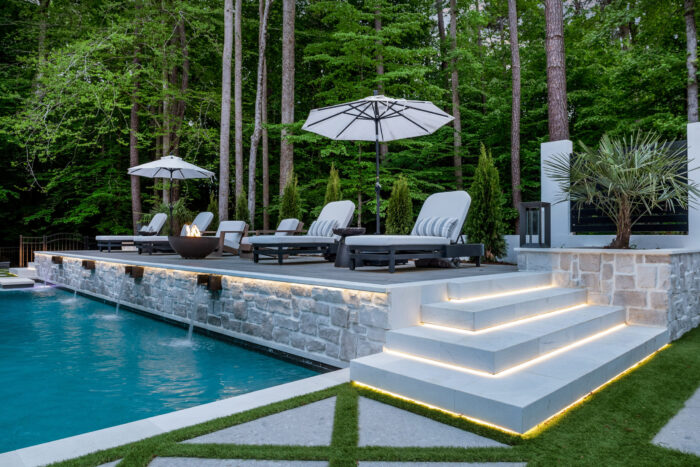
A flat lot gives you more flexibility. A sloped lot gives you elevation changes that, when designed around, become architectural assets. Elevated pool decks. Cascading water features. Natural terracing that creates distinct zones within the backyard environment. A pool that appears to float at the top of a tiered landscape.
The homes in the Triangle that have the most visually striking outdoor environments are often the ones on the least cooperative lots. When the design has to respond to topography, it tends to produce something more interesting than a pool dropped into the center of a flat yard. The challenge demands creativity. And creativity produces character.
That said, this kind of work requires genuine engineering expertise, not just a contractor willing to dig where you point. Retaining walls carry structural load. Drainage affects not just your property but your neighbors’. Structural decisions made during pool shell engineering shape what is possible for the lifetime of the project. Getting these elements right requires a design-build partner with deep site experience and a disciplined approach to pre-construction planning.
Retaining Walls: Function First, Aesthetic Always
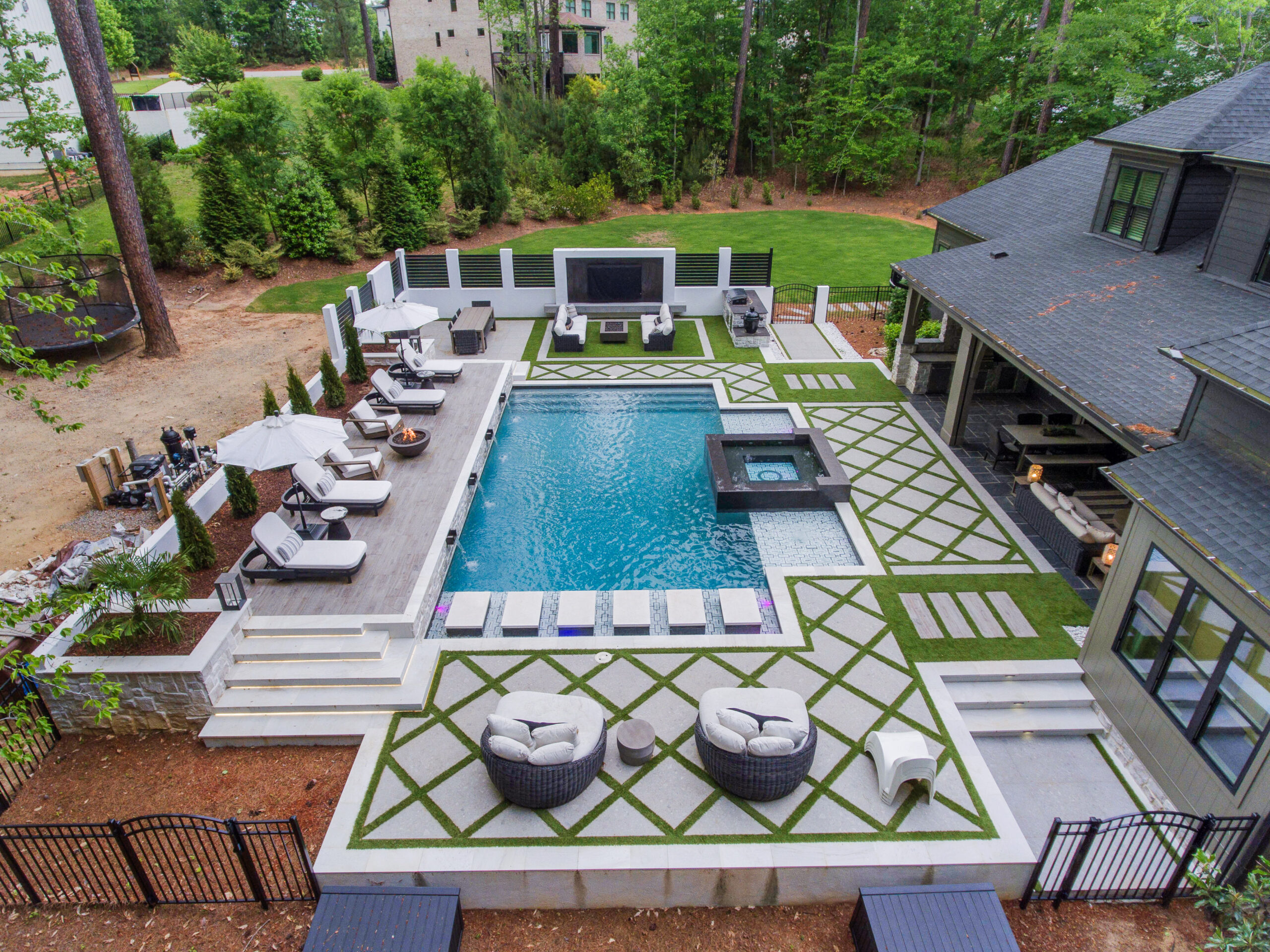
On a sloped lot, retaining walls are often the most consequential structural element of the pool project. They hold back the grade change, create the level pad on which the pool sits, and define the vertical faces of the terraced environment. They are also among the most visible features of the finished backyard.
The structural requirement is non-negotiable: a retaining wall must be engineered to hold the soil load it is retaining over the lifetime of the installation. An underpowered retaining wall fails gradually, and the consequences, settling, cracking, and water intrusion, are expensive to correct and disruptive to the pool environment.
The aesthetic opportunity is significant. A well-designed retaining wall becomes a design feature rather than a construction artifact. Concrete masonry unit walls clad in natural stone or stucco read as architectural elements that anchor the pool in the landscape. Dry-stacked stone walls, where appropriate, add a natural, sculptural quality. The choice of material and cap detail connects the wall to the rest of the outdoor environment’s material palette. For a deeper look at how material continuity works across a full pool project, our post on the best pool deck materials for Cary, Durham, and Chapel Hill covers how travertine, porcelain, and natural stone perform across different surface types and applications.
In many of the most compelling hillside pool projects across North Carolina, the retaining walls are not background structure. They are the design. The pool sits within an architectural frame that makes the entire backyard feel like a built environment, intentional and complete.

Raised Pool Walls: Elevation as a Design Move
In cases where the lot slopes away from the house, a raised pool wall allows the pool to sit at a higher elevation than the yard beyond it. From the pool deck, the effect is dramatic: the pool edge appears to float against the landscape below, with an unobstructed view of the property or neighborhood beyond.
This configuration requires a perimeter wall on the downhill side of the pool, engineered to handle both the pool water load and the soil differential on either side. When properly specified, these walls are as durable as any standard construction. When combined with a vanishing edge, where pool water appears to spill over the far edge into the landscape below, the visual effect is among the most striking in residential pool design.
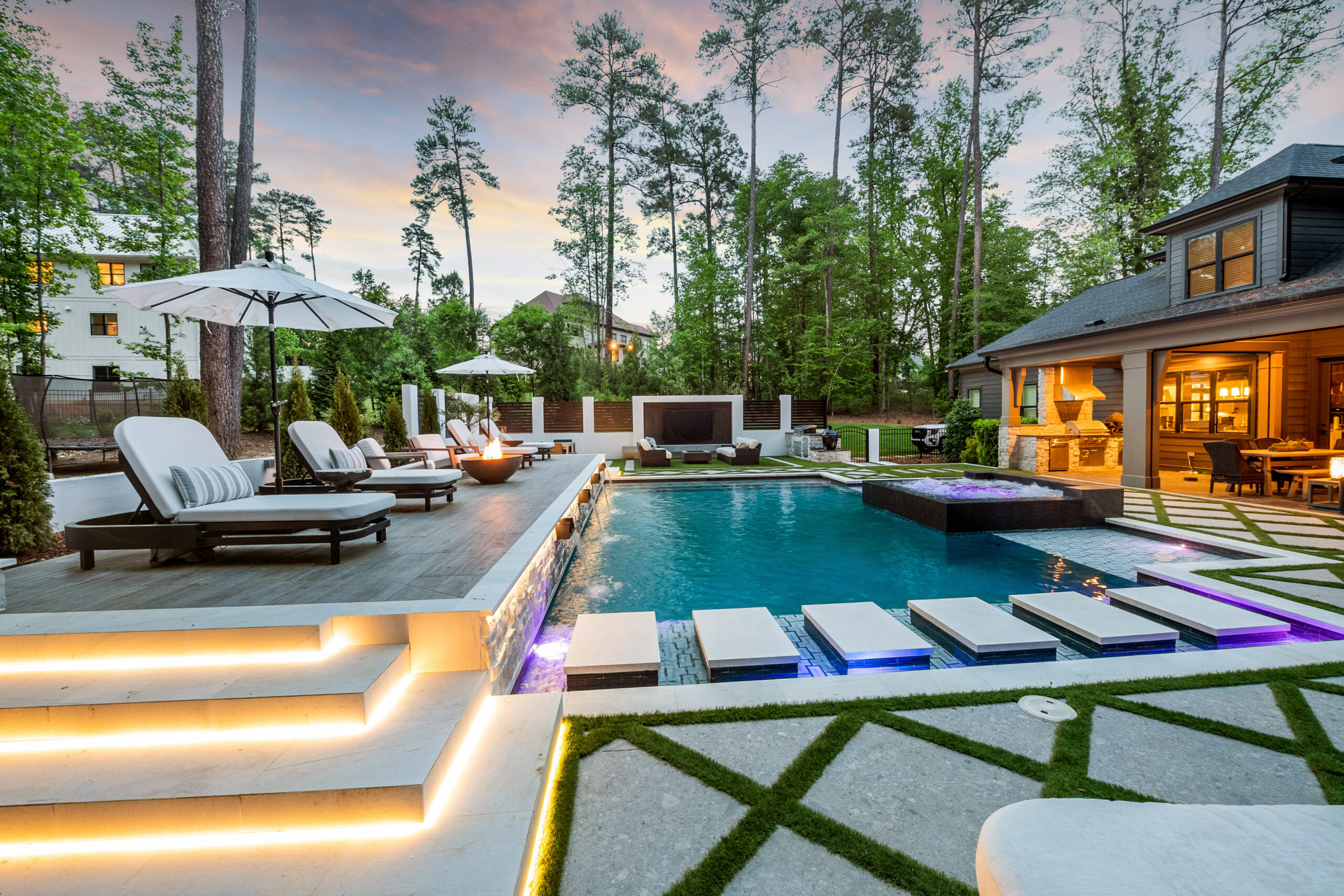
Raised pool walls also create usable vertical face on the downhill side, which can support water features such as sheer descents or deck jets aimed at a lower terrace. They can also serve as a backdrop for architectural lighting and plantings that extend the design downward through multiple levels of the yard.
Drainage: The Engineering Problem That Determines Everything
On a flat lot, drainage for a pool is a straightforward calculation. On a sloped lot, it is a more complex problem with consequences that extend beyond your property boundaries. North Carolina’s Sedimentation Pollution Control Act requires an erosion and sedimentation control plan for land-disturbing activity affecting one acre or more, a benchmark that intricate, multi-level pool installations often reach.Water moves downhill. Pool water that splashes out, rainwater that falls on an elevated deck, and runoff from grading changes all need somewhere to go. An engineering failure in drainage design can result in water pooling against retaining walls, saturating adjacent soil, washing out plantings, or running into neighboring lots.
A competent design-build partner engineers drainage from the beginning, incorporating surface drainage channels, subsurface French drains, and grading slopes into the overall site plan. This work is not glamorous and it is not visible in the finished product, but it is one of the clearest indicators of whether a contractor approaches complex sites with the rigor the work requires. Drainage planned before the first excavation pass is always less expensive and more effective than drainage retrofitted after problems appear.

Transitions Between Levels: Where the Experience Comes Together
On a terraced lot, the transitions between levels, whether steps, ramps, or grade changes into patio areas, are where the experience of moving through the backyard is defined. These transitions can feel awkward and utilitarian, or they can feel as designed as the pool itself.
Steps between terraces should be wide enough to be comfortable and scaled to the visual weight of the overall environment. A broad staircase from an upper terrace to a lower patio signals intention. Narrow utilitarian steps signal a contractor who built what was required, nothing more. The material of the steps should continue the deck material palette rather than introducing a new element at the very moment the design most needs coherence.
Planters, walls, railings, and built-in seating integrated into level transitions soften the grade changes and add genuine livability to what might otherwise be dead space. A pool on a sloped lot has the opportunity to be an entire vertical environment, with distinct zones at different elevations that each feel complete and inhabitable on their own terms.
A Complex Lot Is Not a Barrier. It Is a Different Brief.
The homeowners who build the most extraordinary outdoor environments in the Triangle are often the ones who started with the most complicated lots. The complexity did not stop them. It gave their designers something worth solving.
Jim Hinson Pools has been building on sloped, terraced, and complex lots across North Carolina since 1970. The question is never whether it can be done. It is always how to do it in a way that makes the complexity disappear into the design and the design stand forward as the thing you notice.
Schedule a site feasibility consult with Jim Hinson Pools to get a clear read on what your lot can support and what the design possibilities actually look like.